7 Steps to Finding the Perfect Meme Coin Entry Without Chasing Pumps
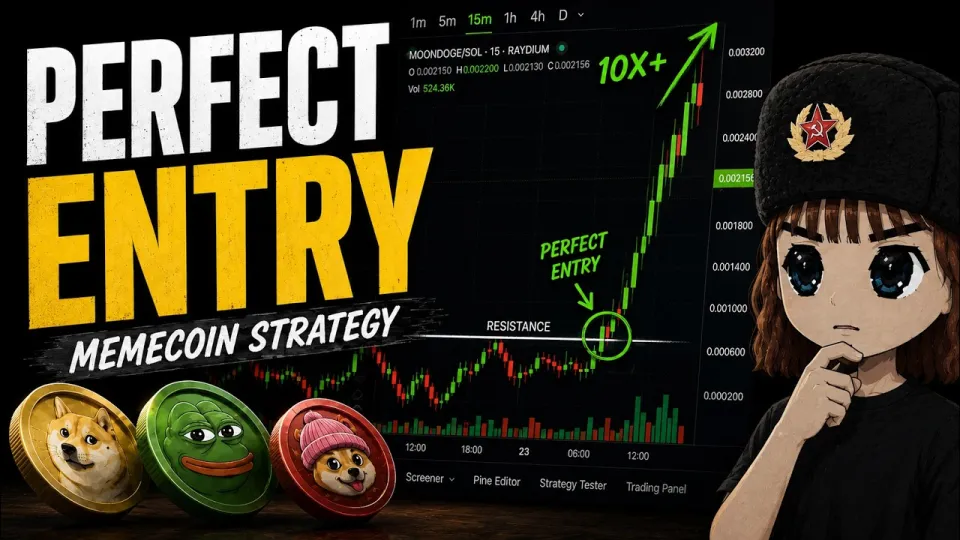
Video: How I Find the PERFECT Entry on Memecoins 📈 (Full Strategy)
Need articles like this for your video? They help promote it on YouTube and Google — order them in the Telegram bot @sat_sit_bot. The bot writes and publishes the articles itself (with your YouTube video embedded) on popular topical websites (no ads). Your first 50 articles are free.
A meme coin entry is a planned decision to buy at a specific price level where chart structure, volume and risk-reward line up, rather than a reaction to a green candle. The process starts with the chart, not the narrative: you wait for a defined level, confirm momentum with volume, and size the position so that a failed setup costs a small, known amount. Traders who want the full toolkit for paper trading, sniping and copy trading before risking real funds can get early access through the Plasma Telegram group.
Meme coins are the most timing-sensitive corner of crypto. A token can have a real narrative, an active community and a listing on every terminal, and still hand you a 40% drawdown within minutes if you bought the third vertical candle. The framework below is the one broken down on the starwifpump channel: no predictions, just repeatable conditions that decide whether a trade deserves your capital.
Why the entry matters more than the coin on meme coin trades
On a meme coin, the difference between a good and a bad entry is usually the difference between a 1:3 and a 1:0.5 risk-to-reward on the exact same token. Because these assets move 30–80% in hours and have thin order books, a late entry forces a stop loss so wide that one loss wipes several wins. Entering early on a confirmed level lets you place the stop just below structure, where invalidation is objective and cheap.
This is why experienced traders talk about setups instead of picks. Picking is the easy half: trending tickers, social volume, holder growth and dev wallet checks are all public. Timing is where discipline shows up, and it is the part beginners skip when a chart is already vertical.
The 7 steps to a clean meme coin entry
A clean entry is built in sequence, and each step can veto the trade. Skipping a step is how FOMO gets in.
- Check the structure first. Look for a series of higher lows on the 1-minute to 15-minute chart. If price is making lower highs, there is no setup regardless of how good the narrative looks.
- Mark the levels that matter. Identify the launch range, the first consolidation box, the prior swing high and any level that was broken and reclaimed. These are the only prices where an entry has a defined invalidation point.
- Confirm momentum with volume, not candle size. A healthy move expands volume on the impulse and contracts it during the pause. A pump on falling volume is usually a distribution candle in disguise.
- Wait for the pullback. The best entries come on a retest of broken resistance or the top of the previous consolidation range, not on the breakout candle itself.
- Define invalidation before the buy. Decide the exact price where the idea is wrong — typically just below the reclaimed level or the last higher low — and calculate position size from that distance.
- Plan exits in advance. Set a first partial around the prior high or a measured move of the consolidation box, and trail the rest behind higher lows.
- Re-check liquidity and holder distribution. A perfect chart on a token with a single wallet holding 30% of supply is not a setup; it is a trap with a nice pattern.
Momentum without chasing the pump
Momentum confirmation means the market is still accepting higher prices after a pause, and the cleanest way to see it is a shallow pullback that holds above the breakout level on declining volume. Chasing means buying the extension candle, where your stop has to sit far below and any routine wick takes you out.
The practical rule: if the move from the base is already more than roughly two to three times the height of the consolidation box you were watching, the low-risk entry has passed. Either wait for a new base to form or skip the token. There is always another meme coin; there is not always another bankroll.
Pullbacks and support levels that improve risk-to-reward
A pullback entry buys strength retested as support, which shrinks the distance to your invalidation level and multiplies the reward per unit of risk. Three structures are worth memorising:
- Break-and-retest: price breaks a prior high, pulls back to it, and holds with a wick and a bounce. Stop goes under the retest low.
- Range reclaim: price falls out of a consolidation box, then reclaims the box floor. The reclaim is the entry, the box floor is the invalidation.
- Higher-low continuation: after an impulse, price prints a higher low above the previous base. Entry on the turn, stop under that low.
In all three, the entry is a limit order at a level, not a market order into a moving chart. That single change removes most emotional buying.
Red flags that say do not enter
Some charts are telling you to stay out, and reading them is a skill in itself. Skip the trade when price is vertical with no base, when volume fades on each new high, when the token has just printed a huge wick that was immediately sold, or when liquidity is thin enough that a normal-sized order moves the price several percent.
On-chain red flags count too: a dev wallet or a cluster of fresh wallets holding a large share of supply, a contract with mint or freeze authority still active, or a token whose entire volume comes from one pair with almost no holders. A beautiful chart cannot fix a distribution problem.
How to plan risk, exits and profit-taking before the trade
Risk planning on meme coins means deciding the maximum loss in currency terms first, then letting the chart decide the position size. If your invalidation is 25% below entry, a position sized for a 2% account risk is automatically four times smaller than one with a 6% stop — the math protects you from the volatility these tokens carry.
A workable template: take 30–50% off at the first target (prior high or measured move), move the stop to breakeven, and trail the remainder under higher lows. If the token never reaches the first target and breaks structure instead, exit at the invalidation without renegotiating the level. Most accounts die from moving stops, not from bad picks.
Common questions from newer meme coin traders
Beginners arriving from the starwifpump breakdown tend to ask the same handful of things: which chain to trade, which trackers and filters to use, and whether a small account is even worth starting. On chains, the framework is chain-agnostic — Solana, Base or any other fast chain works the same way, but liquidity depth and terminal tooling differ, so check where volume actually is before choosing. On trackers, filters usually combine market cap range, liquidity minimum, age of the pair and holder count, which is enough to cut the noise to a watchlist you can actually monitor. And on small accounts: trading 200 dollars with the same rules as a large one is fine, as long as position sizing keeps any single loss small — the process, not the balance, is what you are practising.
Useful links
- Plasma Telegram (early access, updates, setup help): https://t.me/+PF-2KHPgQqFiZWJh
- Discord community: https://discord.com/invite/fr6zzYyBxC
- Padre trading terminal: https://trade.padre.gg/rk/star
- Solpump: https://solpump.com/a/STARGOAT
- starwifpump on X: https://x.com/starwifpump
Bottom line
Meme coin entries are a process, not a prediction: structure first, volume confirmation second, pullback entry third, and a pre-calculated invalidation level before any capital leaves your wallet. The seven steps above are deliberately boring, and that is the point — boring entries are repeatable, while exciting entries are usually someone else's exit liquidity. The starwifpump channel walks through the same framework on live charts, which is the fastest way to train your eye on what a valid retest looks like versus a failing one. Start with paper trading or a very small size, keep a record of every setup you take, and let the risk-to-reward statistics tell you whether your entries are improving. For tooling and community support while you practise, join the Plasma Telegram group and work through the steps on charts before you size up.
Key takeaways
- Most meme coin losses come from timing the entry wrong, not from picking the wrong ticker.
- A valid entry needs structure first: higher lows and a reclaimed level, not a green candle.
- Momentum is confirmed by volume expansion and consolidation, not by the size of the last pump.
- Pullbacks to broken resistance or the prior consolidation range give the best risk-to-reward.
- Exit and invalidation levels are defined before the buy order, not after price drops.
Questions & answers
What is the best entry point on a meme coin?
The best entry is a retest of a level that was just broken, such as prior resistance or the top of a consolidation box, with the stop placed just below that level. This keeps the invalidation close and gives the trade a favourable risk-to-reward instead of forcing a wide stop under a vertical candle.
How do I avoid FOMO when a meme coin is already pumping?
Decide in advance that you only buy at marked levels, and accept that a move which has already run two to three times the height of its base is no longer a low-risk entry. Waiting for a new base or skipping the token entirely is a valid outcome — there is always another setup.
Does the same entry strategy work on every chain?
The structure, volume and risk rules are chain-agnostic and work on Solana, Base and other fast chains. What changes is liquidity depth, terminal tooling and how quickly rugs happen, so check where real volume sits and adjust position size to the thinner order book.
How much should I risk on a single meme coin trade?
A common approach is to risk a small fixed percentage of the account per trade, typically 1–2%, and let the distance to the invalidation level determine the position size. With stops often 20–30% below entry on meme coins, that means much smaller positions than most beginners expect.
Source: How I Find the PERFECT Entry on Memecoins 📈 (Full Strategy) · Markdown version